Featured post

Please read: What to do if the links to transcriptions don't work

😩  All the links embedded in posts before 1 August 2020 are broken. As a workaround, please go directly to my repository on Google Drive  ...

Wednesday, 6 January 2021

Robinson: Walking in a Country Towne

  A gentle stroll with a contemporary of John Dowland


Thomas Robinson (c 1560 – c 1610) was a lutenist who published a tutor for lute (The Schoole of Musicke) in 1603. This piece is the first of a number of his works that I have transcribed for low-G ukulele, and will be posting over the next few weeks.


The repeats in his music do not always work seamlessly, so you may want to make suitable modifications, which is presumably what his contemporaries would have done.

Available for free download in the following formats:

Wednesday, 2 December 2020

Dowland: Preludium (P 98)

 A simple beginning, but later ... 


SOURCE: Poulton D, Lam B, Eds. 1995. The collected lute music of John Dowland, Edn 3. Faber Music, London. 


The original is in the Margaret Board Lute Book (c. 1620), f. 29, a didactic MS. She was taught by Dowland, and judging by the second half of the piece she must have been a pretty good player. 

I have included the original indications of RH fingering and of graces (relishes) from the transcription of the MS. I have replaced the original dot-grace with a ˚ because of the constellation of dots. The kinds of grace referred to by the symbols are not known. 

The dots under the notes specify where the 1st and 2nd RH fingers should be used. Following the MS not all bars are fingered, but those that are notated specify this pattern: the stronger notes are played with the second finger and the weaker with the first. The same pattern was presumably used for the other bars. The thumb is usually used for the bass voice.

You can hear a brilliant version played on lute by “Luthval”, by searching on YouTube; he plays at about 38 bpm, which sounds slow at first, but proves to be a sound choice.

Available for free download in the following formats:

Monday, 30 November 2020

Dowland: An Almand (P 96)


  •   A lively dance  

Arranged for ukulele from the transcription in Poulton D, Lam B, Eds, 1995, The collected lute music of John Dowland, Edn 3. Faber Music, London. The original is in the Margaret Board Lute Book, f. 13, c. 1620, a didactic MS. 

Margaret Board was taught by Dowland and must have been a pretty good player. 

I have included the original indications of RH fingering and of graces (relishes) from the transcription of the MS. I have described the Renaissance fingering convention here . 

For the grace symbols I have replaced the original dot with a ⸰ because there are so many other dots. The kinds of grace referred to by the symbols are, however, uncertain. 

The first two lines of the piece in the Board Lute Book, showing the fingerings and graces. 

It's an attractive little piece, which Nigel North plays at a cracking 80 bpm. Good luck!

Available for free download in the following formats:

Friday, 27 November 2020

Dowland: Lady Hundson's Puffe (P 54)

   A lively dance  

 A “puffe” was a vigorous dance that put you out of breath, which indicates how this piece should be played. It is arranged for ukulele from: Poulton D, Lam B, Eds. 1995. The collected lute music of John Dowland, Edn 3. Faber Music, London. 

Lady Hundson
painted by Nicholas Hilliard

Elizabeth Spencer, Baroness Hundson (1552 – 1618) married George Carey, 2nd Baron Hundson (a grandson of Anne Boleyn’s sister) in 1574. She was a scholar and a patron of the arts, including John Dowland. She survived her husband, a diplomat and soldier, who died of VD and mercury poisoning in 1603. She was painted by Nicholas Hilliard (c. 1547 – 1619)

The different Mss that P&L examined vary in the barring and in the dispositions of the four strains. The version they chose is barred in 4/4 time, but another has it in 2/4 time, and this is what I have done here as I find it easier to read. In P&L we have strains A, A’ (8 bars each), B (6 bars), C (8 bars), D (10 bars), but another MS ends with a reprise of C. So, it’s up to you.

Strain B begins with a version of the first bars of A, but built on F (on the ukulele) rather than G. It seems to be 2 bars short, but I have checked with facsimiles and it seems to be thus.

The use of the chord of F, VII in the key of G, occurs in bars 6, 14, 18, 20 and 36. It is reminiscent of the beginning of the passamezzo antico sequence, and adds to the charm of the piece. Indeed, Diana Poulton mentions “most attractive”, “charmingly fresh melody”, and “shapely and elegant”. I would add that it’s also good fun to play. I have tried to get a good movement in the lower voice, although it has been raised an octave, and in places if feels like a duet.

Available for free download in the following formats:


Thursday, 26 November 2020

Cutting: The Wood so Wild

 Well, it starts off easy ... 


"The Wood so Wild" was an air popular in Tudor times, despite which the words are mostly lost. It is based on very simple and familiar chords, but sounds rather strange to modern ears because it is in a mode (Lydian or Myxolidian) that is uncommon nowadays. For more information see https://tunearch.org/wiki/Annotation:Woods_so_Wild_(The).

Frolics in the wild wood


It was arranged for lute by Francis Cutting (c 1550 – 1595) from a version by William Byrd, and also by amateurs in The Ballet Lute Book (ukulele arrangement appended) and in the Lodge Lute Book (which is beyond my powers of transcription).

 If you search on YouTube you will find a fine version played on lute by the late Julian Bream. To follow his example it should be played energetically, with a strong pulse.

Sources: A transcription of the lute version of Cutting’s piece is published on Sarge Gerbode’s incredible website, but I can’t find its provenance. The very basic piece is from the Ballet Lute Book Trinity College Dublin, Ms 408/2, f. 84.


Available for free download in the following formats:


Tuesday, 24 November 2020

Cutting: A Galliard

  A piece by one of Dowland's circle 

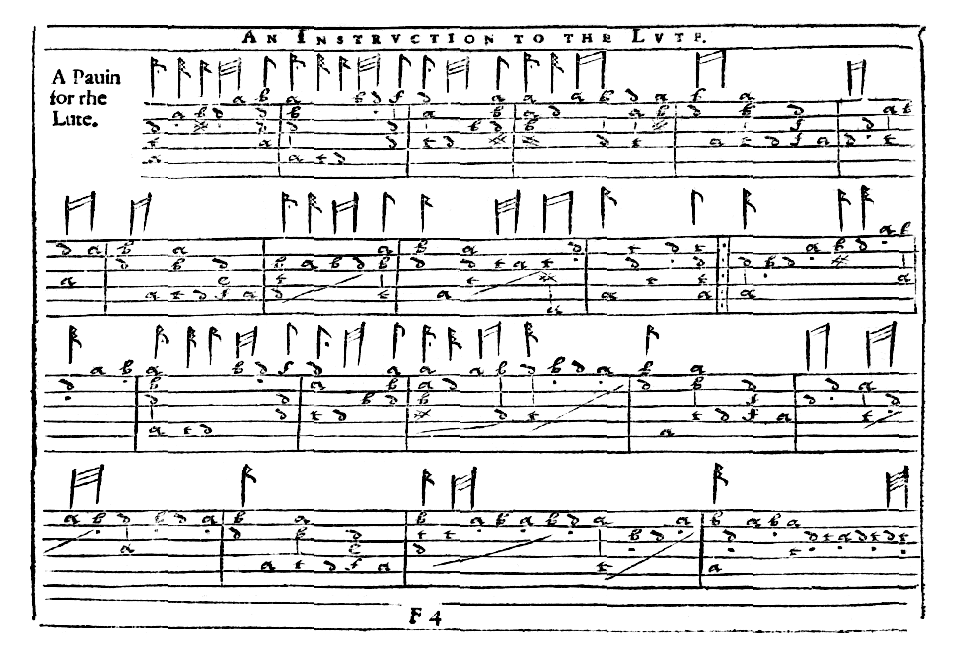
Francis Cutting (1550 – 1595) was about 13 years older than John Dowland, who admired his compositions. This piece, referred to elsewhere as “the Bray Pavan” based on a piece by William Byrd, which to my eyes it does not ressemble in the slightest. In the book it is labelled “A pavin for the lute” at the beginning, and ”A galliarde by Fr. C” at the end. It is obviously a galliard.


William Barley (1596) A new book of tabliture for the Lute and Opharion, London.
The galliard is on pp 76 – 78


It is made up of three strains, each with a repeat in variation. Some bars have a 6/8 rather than 3/4 feel, and I have formatted the notes appropriately. It is a relatively easy piece, with a few challenges – good luck!

I am not happy with bar 18 (in strain A’): it should be a variation on bar 8 (in strain A), around the chord of Am, but is based mostly on the chord of Bb or Gm. Meanwhile, the rest of A’ is close to A. I prefer to play bar 8 (or an elaboration of it) rather than bar 18. My unhappiness is supported by John Dowland’s complaint that Barley had not only plagiarised his lute solos, but also that they were corrupt.

A facsimile at Royal Holloway College can be seen here: http://purl.org/rism/BI/1596/20/1. 

A sometimes clearer facsimile of presumably another printing, is here: http://www.lutemusic.org/facsimiles/BarleyW/A_New_Booke_of_Tabliture_1596/f4.png

Available for free download in the following formats:


Sunday, 22 November 2020

Lodge & Le Roy: Three Passamezzos

 Three more easy ones 


It was common practice in the Renaissance for musicians to make compositions based on the grounds (or more, accurately, harmonic sequence) of the Passamezzo Antico. I have discussed these grounds in an earlier post, with examples. Various dance vrhythms could be used, such as the galliard and pavane.

In England they would be called various forms of the word "passamezzo".  


Here we have three easy versions which I have garnered from the excellent 58 Very Easy Pieces for Renaissance Lute, pub. The Lute Society, 1999. 

  • Pasa Mesure Galiarde (the Lodge Lute Book)
  • The Pass a Measures Pavion (Lodge)
  • Passamezze (Le Roy)

A typical Passamezzo Antiqua would be a version of the following ground (chord sequence):

i       | VII    | i      | V     |

III     | VII    | i, V   | I     ||

 Each bar may be represented by several bars, or just part of a bar.

The three examples here follow the pattern quite closely, but with the III replaced by i. All the originals are set in C-minor which, when transcribed for the ukulele with fingerings as close as possible to the lute original, results in D-minor. This rather restricts the options for including the bass line. Therefore, I have also included versions in Gm, so that we can use the low bass string; this gives a setting closer to the original, but with a few small challenges.

Sources

1 & 2. The original pieces can be seen here in a facsimile of the Lodge MS at the Folgar Library, Washington.  https://luna.folger.edu/luna/servlet/view/search?search=SUBMIT&q=v.a.159&dateRangeStart=&dateRangeEnd=&sort=call_number%2Cmpsortorder1%2Ccd_title%2Cimprint&QuickSearchA=QuickSearchA

3. Original in Adrian Le Roy’s (1568) Lute tutor:  A briefe and easye instruction … The original French edition can be seen here https://stimmbuecher.digitale-sammlungen.de//view?id=bsb00072004, but does not incluse this piece.

_________________

Available for free download in the following formats: